Your comprehensive guide to global tax trends

Global tax trends in 2026 reflect a tax landscape that continues to evolve at breakneck speed. What began as incremental post-pandemic policy updates has progressed into a full-scale transformation, with a heightened global tax system driven by digitalisation, transparency and global alignment.
This guide explores the most significant tax trends shaping 2026 and outlines practical steps organisations can take to remain compliant, resilient and future‑ready.
Tax trends in 2026 focus on efficient tax administration, real‑time reporting and increasing statutory and tax compliance expectations. For companies operating across borders, 2026 is a pivotal year that will require structural change and proactive planning.
These are the top tax trends that companies should prepare for in 2026.
Global tax trends in 2026
1. E-invoicing mandates in 2026 - the new era of digital tax compliance
E‑invoicing becomes a dominant feature of tax administration in 2026, with many jurisdictions shifting from fragmented post-audit models to real-time clearance systems and structured reporting. Mandatory e-invoicing enhances tax compliance and significantly reduces fraud, making it one of the most impactful drivers of global tax transformation.
Key developments
- Belgium & Croatia: mandatory B2B e‑invoicing from January 2026 through Peppol networks
- France: a dual mandate for B2B e‑invoicing and centralised e‑reporting starting in September 2026 for mid-to-large enterprises
- Poland: KSeF clearance system becomes mandatory for large taxpayers in February 2026, with a full rollout expected by April
E‑invoicing mandates require companies to align statutory and tax compliance processes with real‑time controls. This includes integrated enterprise resource planning (ERP) systems, structured invoice formats and managing country‑specific clearance requirements to avoid rejected invoices, failed audits and penalties.
Actionable insight: implement ERP localisation for structured reporting.
Companies must implement well-planned ERP localisation projects that deliver the desired benefits in every jurisdiction where they operate. For a detailed look at the dynamics of ERP localisation, read our practical guide to managing ERP localisation projects.
2. E-reporting & Continuous Transaction Controls (CTC) - transforming digital tax reporting
In 2026, e‑reporting will mature into CTC, transforming how tax compliance operates across industries. Driven by the EU’s VAT in the Digital Age (ViDA) initiative and other similar frameworks, tax authorities are increasingly requiring instant or near‑instant access to transactional data rather than periodic submissions.
Key global movements
- Spain and Greece expand real‑time VAT reporting requirements via VeriFactu and myDATA, respectively
- SAF‑T enforcement tightens in Romania and Bulgaria, while hybrid models evolve in Hungary and Portugal
- Extended Producer Responsibility (EPR) reporting gains traction, linking sustainability metrics with tax compliance
The shift to CTC means tax administration is becoming a continuous digital audit. Errors that once surfaced during annual filings now appear within hours of transaction execution.
Actionable insight: invest in automation for continuous transaction monitoring.
Companies must invest in digital reporting systems for continuous transaction monitoring, supported by automated validations and exception workflows, that can build bridges between tax processes and business operations. For more on the progression of tax reporting, read our article exploring the digitalisation of tax operations.
3. Global minimum tax & Pillar Two - the next phase of global tax transformation
Among the most important global tax trends in 2026 is the operational rollout of the OECD’s Pillar Two framework, which establishes a global minimum corporate tax rate of 15% for MNEs, thereby preventing multinational organisations from making use of low-tax jurisdictions.
By the end of 2026, most participating jurisdictions will have implemented a 15% global minimum tax through Qualified Domestic Minimum Top-up Taxes (QDMTTs), Income Inclusion Rules (IIR) and Undertaxed Profits Rules (UTPR).
What’s changing in 2026
- Evolving OECD guidance: the OECD has refined the rules on deferred tax assets and safe harbours, introducing additional compliance complexity and increased reporting obligations
- Jurisdictional rollouts: countries including the Netherlands and South Africa have already enforced legislation, with many more going live in early 2026
- Granular data demands for MNEs: multinational groups exceeding €750m in revenue must comply with GloBE reporting demands and reconcile local statutory and tax compliance requirements with global corporate tax obligations
Pillar Two shifts tax administration from an annual assessment to a core tax exercise requiring continuous governance.
Actionable insight: prepare for granular data collection and reconciliation.
Organisations must prepare for a level of corporate tax compliance that is far more data‑driven than in previous cycles. ERP systems and automated tools compile all corporate income tax data points into one data source, putting companies in a better position to manage the requirements of Pillar Two. Find out how to navigate tax compliance requirements in this article on five steps to managing tax complexity.
4. Digital tax administration & AI integration - the future of tax compliance
Tax Administration 3.0 is redefining the global tax landscape, moving beyond digitisation into AI-driven compliance ecosystems. 2026 marks the rise of predictive analytics and AI-assisted audits, from HMRC’s Making Tax Digital for Income Tax Self Assessment in the UK to Latin America’s real-time clearance models, reshaping how companies manage statutory and tax compliance.
Key accelerations
- AI analytics for risk profiling: tax authorities use advanced machine learning to identify anomalies and potential fraud in real time
- Generative AI in tax departments: from drafting memos to monitoring legislation and enhancing transfer pricing analysis, generative AI enhances efficiency
- ERP integrated tax systems: as fragmented tax data becomes a serious liability, ERP integrated systems are essential for data readiness and compliance
AI tools are powerful, but there are potential pitfalls to consider. High‑quality data is a must, as poor data governance can lead to misclassifications and non-compliance. Data structure is also important; systems should be integrated to cover all data points, but local expertise and human oversight remain essential. Finally, companies should understand the risks of incorporating too many tax tools or too much automation into their toolkit, which can lead to errors that cause compliance issues.
Actionable insight: invest in AI‑enabled tax engines but customise them to fit.
The nature of tax is extremely complex, with tax types and local legislation being just two of many intricacies. A one-size-fits-all approach to AI tools doesn’t work. Companies should carefully select tools tailored to their needs, and pair them with robust data governance rules that align with their tax strategy.
Strategic insights for businesses navigating tax transformation in 2026
There are three strategic areas that businesses must consider when navigating tax in 2026.
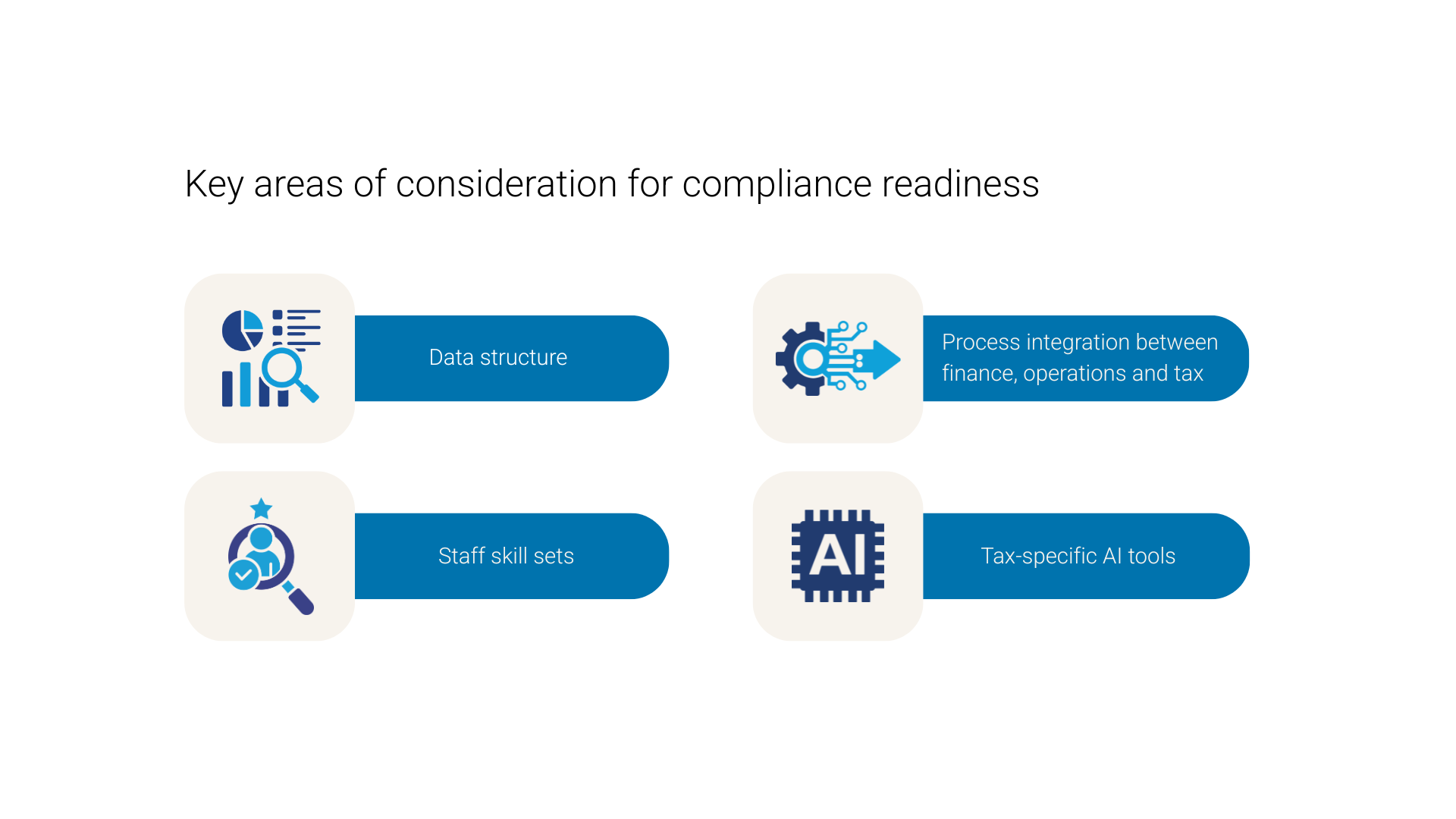
1. Compliance readiness
Compliance readiness in tax involves making sure that an organisation’s data, systems, processes and people are fully prepared to meet evolving tax obligations without disruption. This includes aligning tax planning with GloBE rules and Pillar Two requirements.
2. ERP localisation & integration
Companies must audit their tech stack to ensure their ERP systems can handle structured invoice formats and real-time reporting, creating scalability opportunities for future tax transformation needs.
3. Workforce upskilling for digital tax tools
With the rise of digitalisation in tax, businesses must have the right experts in their corner, requiring them to balance the cost of hiring tax experts with outsourcing to a service solutions provider. Read more about the impact of digital tax on the workforce in this article on the digitalisation of tax reporting for global businesses.
Top 5 takeaways on global tax trends 2026
- Pillar Two compliance is now core, not optional
- E-invoicing mandates go global — real-time is the norm
- Continuous controls redefine tax reporting
- AI transforms tax administration and fraud detection
- Businesses must align tax strategies with digital transformation
Future‑proofing your tax strategy
To stay ahead of global tax trends in 2026, organisations must treat tax digitalisation not just as a regulatory requirement, but as a strategic advantage. Investing now in technology, data quality and workforce capability will safeguard compliance and improve operational efficiency.
Connect with our experts to keep your business compliant and competitive.
Contact us today or find out more our tax compliance services here.