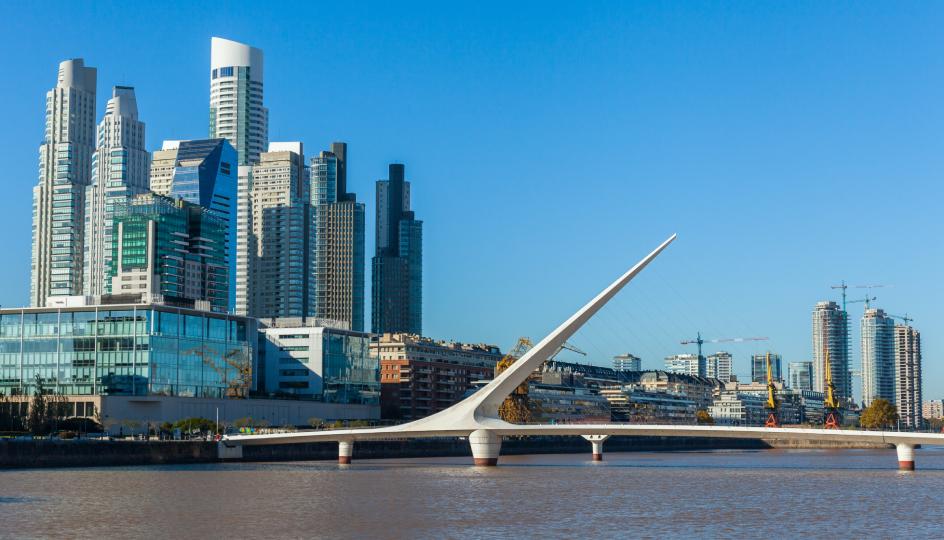
Doing business in Argentina

As the second-largest country in Latin America, Argentina has emerged as an attractive marketplace for global investors. However, the country’s history of high inflation, currency devaluation and political instability increases the risk of doing business there. Companies looking to expand into Argentina must build up a thorough understanding of the economic landscape and the country’s evolving regulatory environment.
Argentina, officially the Argentine Republic, is Latin America’s third-largest economy. The country comprises a federation of 23 provinces as well as the autonomous city of Buenos Aires.
Argentinians have a good quality of life, resulting in a ‘very high’ rating on the Human Development Index. The country actively pursues strong international relations and is a prominent member of several international trade associations, including MERCOSUR (Southern Common Market), G20 and the Cairns Group.
It also benefits from rich natural resources, a highly literate population, an export-oriented agricultural sector and an increasingly diversified industrial base.
| Fast facts: |
|
While there are many benefits associated with doing business in Argentina, there are also certain challenges to negotiate. The country is ranked 9th in the world for the complexity of its business environment in TMF Group’s Global Business Complexity Index 2026.
There are a number of economic and political factors in play that impact business conditions. Argentina has a history of high inflation, currency devaluation and political instability, all of which increase investment risk.
It is therefore important that companies doing business in Argentina take the time to build up a thorough understanding of the economic landscape and its evolving regulatory environment.
Advantages to doing business in Argentina
There are many advantages to doing business in Argentina. As the second-largest country in Latin America, it has emerged as an attractive marketplace for global investors. It is a complex market, but one that is full of opportunities for foreign companies.
Investors can tap into a local consumer market that has just hit 46 million people as well as the huge potential in the lithium, oil, mining, renewable energy, agribusiness and financial services sectors. Many of the biggest multinational companies in the world now have a growing presence in Argentina, as the country continues to grow its vast range of industries.
Investment opportunities continue to expand across several strategic sectors and regions. The Neuquén Province has become increasingly important due to the ongoing development of Vaca Muerta, one of the world's largest unconventional oil and gas reserves. The project continues to attract domestic and international investment and has strengthened Argentina’s position as a key energy market in Latin America.
Recent activity in international capital markets also reflects improving business confidence. Several Argentinian companies have successfully accessed international financing through corporate bond issuances and debt restructuring transactions, demonstrating renewed investor interest in selected sectors of the economy.
Argentina has signed free trade agreements with several countries as well as certain international organisations. Through MERCOSUR, for example, it has free access to trade with its Latin American neighbours, including Brazil, Paraguay and Uruguay, and enjoys limited taxes and minimum legal requirements.
The recent EU-MERCOSUR trade agreement is also expected to create additional opportunities for investment, trade integration and market access between Argentina and European countries, further enhancing the country's attractiveness as a regional business hub.
In recent years, Argentina’s government has approved a number of key initiatives to encourage foreign investment. These include the Agencia Argentina de Inversiones y Comercial Internacional, which provides free assistance to foreigners interested in doing businesses in the country and the Argentine Simplified Share Company (SAS), a legal entity that makes it easier for foreigners to set up businesses in Argentina.
A key tip for doing business in Argentina is to harness the country’s highly educated workforce. Although Argentina’s official language is Spanish, other languages commonly spoken include English, Italian, French and Portuguese.
Argentina also offers a high quality of life when it comes to factors such as education, natural environment and health services. Buenos Aires, the capital city, placed second in Mercer’s Quality of Living City Rankings 2024.
When it comes to the best places for doing business in Argentina, Buenos Aires has an excellent business infrastructure and offers ambitious entrepreneurs a wealth of opportunities. In recent years, the city has seen significant investment in aerospace technology and the renewable energy sector.
Córdoba, Argentina's second most populated city, is another important business hub and a favoured location for many of the country’s startups.
Doing business in Argentina: the culture
When first entering the market, it is crucial that companies carefully consider the impact of culture on business processes in Argentina.
Argentinian business culture values trust, honour and familiarity. The business environment is relationship-driven, so it is important for investors to spend time building networks and cultivating friendships. Flexibility and punctuality are also qualities that are highly valued.
Business structures tend to be hierarchical, with decisions made at the top of the company. Processes can therefore sometimes move slowly due to the need for several layers of approval. The purpose of meetings is more to exchange ideas and discuss them in depth, rather than to make decisions.
When meeting someone for the first time, locals will appreciate any efforts to speak Spanish, but may quickly suggest switching to another language, given the multilingual nature of Argentinian business culture. It is common to hold business dinners in restaurants, but such meals are primarily for socialising and building relationships, so it is best to avoid discussing the specifics of a deal unless your Argentinian colleague brings it up first.
Challenges of doing business in Argentina
Doing business in Argentina can be complex for foreign investors for several reasons. For example, incorporation can be quite cumbersome and slow due to the requirement for multiple points of interaction with the authorities.
Further complexity has arisen in recent years as the high rates of inflation continue to increase. Argentina has historically faced hyperinflation, but the current economic volatility and cost of living pressures in the global market has further compounded this issue.
While inflation remains an important consideration for businesses operating in Argentina, the country has experienced a significant disinflation process since the peak levels recorded in 2023. According to the latest available data based on INDEC statistics, annual inflation stood at 33.6% in May 2026, compared with 211.4% in 2023.
As a result, companies must adjust salaries several times each year. Updating the payroll, contracts and other employee documentation can be time-consuming and costly, impacting the ease of doing business in Argentina.
In addition, over the last 20 years, Argentina has issued foreign exchange regulations restricting the transfer of funds abroad. While foreign exchange regulations remain an important consideration for investors, recent reforms have gradually eased a number of restrictions affecting both financial and commercial transactions. These measures have improved access to foreign currency in certain cases and have contributed to a more predictable environment for international businesses operating in Argentina.
Despite the complexity that inflation causes, Argentina is working hard to become more self-sufficient with fuel and has plans to increase exports in the near future. It’s likely that the global demand for fuel caused by geopolitical conflicts will boost the country’s economy as it steps in to fill the gaps.
Taxes and regulations
Paying taxes can be a complicated process in Argentina, though working with a local partner can help smooth the process. For example, since Argentina does not have a tax treaty with the US, it is important for US expatriates to understand and take full advantage of any tax breaks that apply to their personal financial situation.
The corporate income tax (CIT) rate currently stands at 25%. According to the Federal Administration of Public Revenue, it averaged 33.5% from 1997 until 2022, reaching an all-time high of 35% in 1999 before dropping to a record low of 25% in 2021. [Ganancias-Escala-PJ-2026.pdf]
The standard VAT rate is 21%, but certain transactions are subject to a reduced 10.5% rate whilst others are liable for an increased 27% rate. The 27% rate applies to ‘utilities services’, such as sewerage and energy.
Argentina has adopted IFRS for all companies whose securities are publicly traded, except for financial and insurance entities, which must apply accounting standards issued by the regulators.
Business rules and regulations in Argentina change regularly, which can drive complexity for companies that need to constantly adapt to new ways of working.
As of April 2024, Argentina’s President, Javier Milei, is seeking to implement a sweeping economic reform bill known as the ‘Omnibus Bill’ which, amongst other issues, seeks to privatise state entities and scale back environmental protections in a bid to boost the economy.
Since taking office, President Milei’s administration has implemented a series of measures aimed at reducing regulatory complexity, promoting private sector activity and encouraging investment. Among the most significant initiatives is the Régimen de Incentivo para Grandes Inversiones (RIGI), which seeks to attract large-scale domestic and foreign investment through a combination of tax, customs and foreign exchange incentives, as well as long-term regulatory stability. The regime is particularly relevant for sectors such as energy, oil and gas, mining, infrastructure and manufacturing.
Argentina has also introduced measures to simplify access to its capital markets. In June 2026, the National Securities Commission (CNV) approved a package of regulatory reforms designed to streamline approval processes and expand automatic authorisation schemes for public offerings, financial trusts and investment funds. These measures are intended to improve efficiency, reduce administrative burdens and facilitate access to financing while maintaining transparency and investor protection standards.
The country typically takes a traditional approach to supporting workers, which positively protects employees but can create difficulties for businesses that must meet certain stringent requirements.
Argentina has also recently introduced labour law reforms aimed at modernising employment relations and creating a more balanced framework between employers and employees, following decades of regulations that predominantly favoured employee protections.
HR and payroll
Argentina has a robust labour regulatory framework governed by the Employment Contract Law (Law No. 20,744), which, together with its subsequent amendments, constitutes the primary legislation regulating employment in the country.
For organisations operating in Argentina, regulatory compliance requires ongoing management of labour, social security and payroll obligations. Recent labour reforms have underscored the importance of keeping HR and payroll processes up to date and aligned with current regulations.
At TMF Group, we help organisations efficiently manage the entire employee lifecycle through comprehensive HR and payroll solutions. We support onboarding and offboarding, personnel administration, payroll processing, compliance with legal obligations and regulatory reporting, helping our clients reduce operational risk, maintain regulatory compliance and stay focused on growing their business.
Starting a business in Argentina
The most common types of business entities used in Argentina are corporations, limited liability companies, simplified share companies (SAS) and branches of a foreign entity.
Foreign companies setting up in Argentina must register with the Public Registry of Commerce (Registro Público de Comercio) and the General Inspection of Justice (Inspección General de Justicia (IGJ)) to participate as shareholders of a local company (section 123 of the Companies Act) or to establish a branch (section 118 of the Companies Act).
TMF Argentina has a strong, multilingual team specialising in both local and global requirements for accounting, legal, tax, HR and payroll. Established in 2005, our Buenos Aires office works with business of all sizes who wish to set up or expand their business operations in Argentina.
FAQs
1. Is Argentina a good country to do business in?
Yes. There are a number of advantages to doing business in Argentina. As the second-largest country in Latin America, Argentina has emerged as an attractive marketplace for global investors.
The country has a highly educated, multilingual workforce and a consumer market of 46 million people. It also has vast potential in the lithium, oil, mining, renewable energy, and agrobusiness sectors. Many of the biggest multinational companies in the world now have a growing presence in Argentina.
Argentina has signed free trade agreements with several countries as well as international organisations. Through MERCOSUR, for example, Argentina has free access to trade with its Latin American neighbours, including Brazil, Paraguay, and Uruguay, and enjoys limited taxes and minimum legal requirements.
2. What is the business etiquette in Argentina?
Argentinian business culture values trust, honour and familiarity. The business environment is relationship-driven, so it is important to spend time building networks and cultivating friendships. Flexibility and punctuality are also qualities that are highly valued in a business setting.
When meeting someone for the first time, locals will appreciate any effort at speaking Spanish, but they may quickly suggest switching to another language given the multilingual nature of the Argentinian business culture. It is common to hold business dinners in restaurants, but such meals are primarily for socialising and building relationships, so you should avoid discussing the specifics of business unless your Argentinian colleague brings it up first.
3. What is the ease of doing business ranking in Argentina?
Whilst there are many benefits associated with doing business in Argentina, there are also some challenges to negotiate. The country was ranked the 9th most complex jurisdiction in which to do business in TMF Group’s Global Business Complexity Index 2026.
4. What business is Argentina known for?
Argentina is increasingly recognised for its vast array of industries, but agriculture is the main produce sector. Thanks to its extensive base of natural resources, multiple climate zones and fertile lands, the country is especially well-known for its production of soybeans, wheat, maize, sorghum and livestock.
In recent years, greater opportunities in a wider variety of sectors have opened up, attracting international experts with specific skills. These sectors include manufacturing, telecommunications, oil and gas, automotive, petrochemicals, agrichemicals, pharmaceuticals and renewable energy.
5. What are the business challenges in Argentina?
Doing business in Argentina can be complex for foreign companies for a range of reasons. For instance, incorporation can be quite cumbersome and slow due to a need for multiple points of interaction with authorities.
Further complexity has arisen in recent years due to very high rates of inflation in the country. Argentina has historically faced hyperinflation but the current economic volatility and cost of living pressures in the global market has further compounded this issue.
6. Does Argentina have any trade barriers?
Argentina generally restricts or prohibits the import of remanufactured goods, such as remanufactured automotive parts, medical equipment and information and communications technology products.
The country also limits entry points for several types of goods, including sensitive goods that are specified via 20 harmonised tariff schedule chapters, through specialised customs procedures.
Request our in-depth guide to learn more about doing business in Argentina.
Request now Request now