Fund finance today: from subscription lines to strategic infrastructure

Fund finance now sits at the heart of private market strategy, influencing liquidity, portfolio decisions and performance across the entire fund lifecycle. But as structures become more sophisticated, what separates those who use it from those who use it well? More and more, success depends less on access to capital alone and more on the ability to operate fund finance with precision, transparency and control.
Fund finance is now an established feature of private markets, but its role is continuing to evolve. What was once used primarily to manage short-term liquidity is now being applied more deliberately across the fund lifecycle, shaping how managers deploy capital, manage portfolios and respond to changing market conditions.
This shift reflects a broader evolution in private markets. As structures grow more complex, managers face increasing pressure to operate with greater flexibility and control. Financing solutions are evolving in step, expanding beyond traditional subscription facilities to support a wider range of strategic objectives. As financing solutions have expanded, managers are increasingly integrating them into portfolio construction, liquidity planning and value creation strategies.
It also highlights a more important change. The constraint in the market is no longer appetite. Capital is available, and the lender base continues to expand, including banks and private credit providers. The real question is whether funds can operate these structures effectively, with the data, governance and reporting required to support them.
From liquidity tool to strategic capability
As the industry has evolved, so has the range of financing solutions available to managers. Fund finance now encompasses a broad set of debt solutions secured against investor commitments, fund assets and portfolio cash flows, forming a toolkit that managers can deploy at different stages of a fund’s lifecycle.
At the early stage of a fund, subscription facilities remain the starting point. They allow managers to deploy capital quickly and reduce the need for frequent capital calls. From there, structures become more closely linked to the underlying portfolio.
As funds mature, financing becomes more closely linked to the underlying portfolio. Hybrid facilities begin this shift by combining investor commitments with asset-based collateral, while NAV-based facilities go further by drawing directly on the value and cash flows of the investments themselves. At the more complex end, holding company and asset-level facilities require detailed modelling of cash flows and payment waterfalls. Rather than replacing one another, these structures build progressively, allowing managers to align financing with the stage of the fund, the composition of the portfolio and current market conditions.
This evolution is shaped by broader market dynamics. Slower exits are increasing demand for longer-dated, more flexible solutions, driving the growth of NAV and hybrid facilities. At the same time, the expanding role of private credit providers is widening the range of available structures, while investors and lenders are increasingly seeking greater transparency into portfolio performance, collateral quality and covenant compliance, driving demand for more standardised reporting and automation. Together, these shifts are making fund finance more versatile, but also more operationally demanding.
Where the challenge really lies
Managing a subscription facility is relatively straightforward, but NAV-based and hybrid structures require a different level of operational capability. They depend on information sourced from multiple systems and providers, requiring validation and monitoring. Borrowing base calculations often rely on multiple inputs and methodologies, while cash flows must be tracked across entities and reconciled to complex facility waterfalls. At the same time, reporting must remain accurate, timely and aligned across all stakeholders.
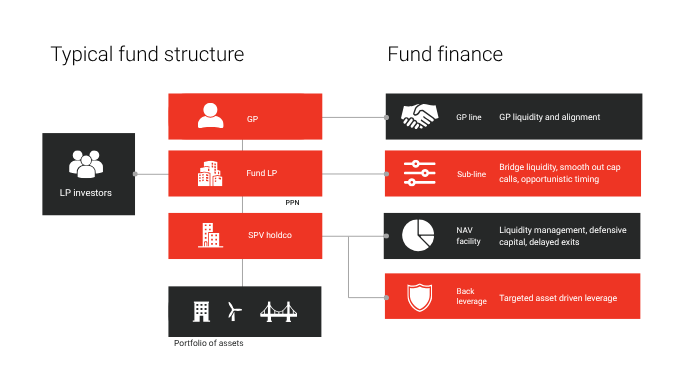
In practice, these requirements place significant pressure on the operating model, particularly where data is inconsistent or delayed. When NAV reporting is not produced in a timely and reliable way, visibility becomes limited. At the same time, cash flows move across funds, SPVs and continuation vehicles, each with its own reporting requirements, and roles between managers, administrators and lenders are not always clearly defined. Many systems are not designed to support this level of complexity, increasing reliance on manual processes and, in turn, introducing additional operational risk.
Why execution now matters more than structure
These operational demands are also changing how lenders and investors assess fund finance programmes. They are placing greater emphasis on the quality of data, the consistency of reporting and the strength of governance. They expect clear visibility across structures, well-defined accountability between stakeholders and independent validation of key calculations. These requirements are not simply a matter of best practice, but a reflection of how fund finance is now used within broader portfolio and liquidity strategies.
This shift signals a broader change in how fund finance is viewed. It is no longer a discrete financing tool that operates alongside the fund. It is part of a wider operating model that must function consistently across structures and throughout the lifecycle of the fund.
As a result, how well a fund is set up to operate has become the key factor. Firms that can produce clear, accurate and timely reporting, supported by strong governance and independent oversight, are better placed to access financing and grow their strategies. Those that cannot may find that increasing complexity makes fund finance harder to use effectively, no matter how much capital is available.
The role of independent, specialist support
Independent administration and specialist support play a central role in making fund finance work in practice. As structures become more complex, managers and lenders need a consistent way to manage data, reporting and day-to-day operations across multiple entities and jurisdictions.
Providers such as TMF Group support this by helping to bring these moving parts together into a single, reliable process. This includes managing borrowing base calculations, monitoring covenants, tracking cash flows across structures. Rather than operating as separate tasks, these activities need to work together to give a clear and accurate view of the position at any point in time.
This becomes more important as more stakeholders are involved. Managers, administrators, lenders and advisers often rely on the same data but use it in different ways. Without a coordinated approach, this can lead to delays, inconsistencies and gaps in reporting. Independent support helps create a shared framework so that everyone is working from the same information, with clear roles and responsibilities.
Independence also plays an important role in building trust. When calculations and reporting are handled on an objective basis, lenders and investors have greater confidence in the outputs, and governance becomes easier to maintain as structures grow more complex.
As fund finance continues to evolve, this combination of clear processes, consistent data and independent oversight allows these structures to operate in a more stable and predictable way.
Fund finance now sits at the centre of how private market funds operate. It supports liquidity, shapes portfolio decisions and gives managers more flexibility in changing market conditions.
But as it has become more widely used, it has also become harder to manage. The challenge is no longer access to financing, but the ability to integrate increasingly sophisticated facilities into a scalable operating model.
Firms that can do this well are better placed to use fund finance as part of their overall strategy. Those that cannot may find that complexity slows them down or limits what they can do.
Talk to us
TMF Group supports fund managers and lenders across the full fund finance lifecycle, providing a range of services including loan and facility administration, borrowing base modelling, covenant monitoring, cash flow tracking and cross-border SPV and fund administration.
Whether you are putting a new financing structure in place or looking to strengthen the way an existing facility is managed, our teams can help bring greater consistency, clarity and control to your operating model. Get in touch to find out how we can support your fund finance strategy.